
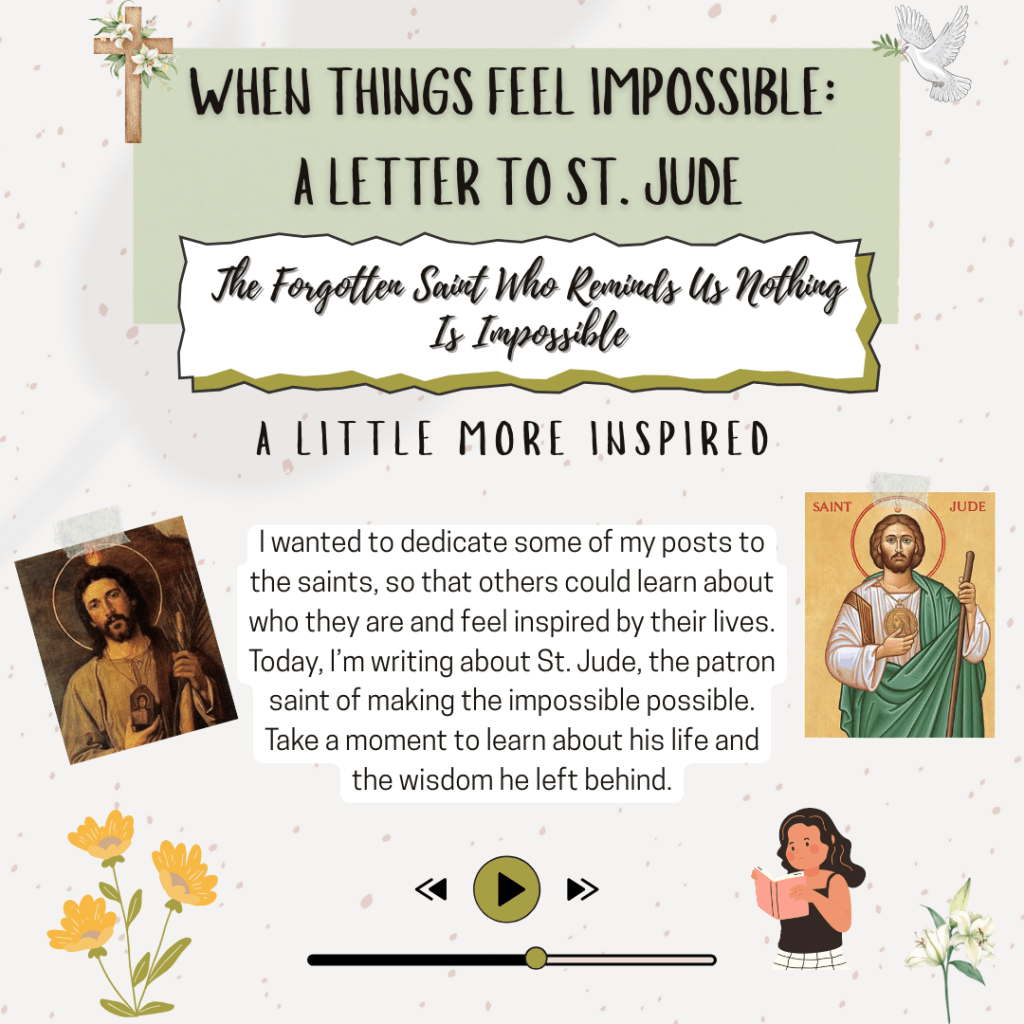
The Forgotten Saint Who Reminds Us Nothing Is Impossible.
If you’d rather listen than read, I’ve added an audio version for your convenience!
I wanted to dedicate a piece of my writing to the saints. So that others may know them as well and maybe be inspired by the lives they lived and their dedication to living virtuous lives that followed the will of the Most High. Personally, I mention this a lot, but I really do want this space to be welcoming to all. I seek to share the things that inspire me, but I want this space of creativity to be a source of inspiration for anyone who loves to learn something new, and who is also curious about spirituality and looking at the world within.
I love the saints, because what better examples could we have than individuals who sought their interior worlds with fervor, dedication, passion, and loyalty? Each one represents different aspects of the human personality and what obstacles can come up during our journey to faith. Each one is unique in personality and experience but all are examples of what it means to follow the divine and His will for our life. I think many people confuse Catholics’ connection to the saints as if we are praying to other gods or putting them above the Almighty—but that is never the case. They are just people who we learn from, for guidance and personal growth, as their lives usually represent some kind of earthly mastery of spiritual things while here on Earth. They intercede for us and pray on our behalf to help us live and grow in the areas we might be lacking in. At least, that is how I see them.
I love to learn about them, especially as I deepen different areas in my life. It not only gives me perspective, but it helps me understand God’s guidance so much deeper. The One above, God Almighty and Jesus, are directly connected to us always. But think of the saints as mentors and guides—human examples of overcoming the obstacles of reaching spiritual enlightenment. Their lives are like maps of different ways to obtain a virtue, that’s all. They are likened energies that have passed along that we can always reference, because this life is hard, and sometimes we don’t know everything. So connect to them as a way to learn and grow.
Today I wanted to talk about St. Jude Thaddeus, also known as the forgotten saint, because he gets confused with the other Jude—you know, the one who betrayed Jesus in the story. Well, St. Jude is a saint I have recently been learning about. I kind of let the saints find me when I need to learn something specific in my life. While I am grateful to mention that I recently accepted a full-time position, I recognize that I did get into moments of despair and desperation. Sometimes my ability to surrender and trust divine timing can be easier to express mentally than truly living it. Anyway, I found a novena to St. Jude one day when I was at this shrine praying, and he happened to be the saint of despair, and of when things feel hopeless and impossible.
For the most part, I am someone who is able to surrender and trust that everything will work out exactly as it’s meant to. But, you know—two years without full time work, a creative breakup with a friend, and everything seeming to not be going my way—it can get to a person. I am a human being. I get sad and frustrated, and sometimes, even through that trust, things do feel quite impossible. So that is when this precious saint came into my life. At a moment when I was in the sanctuary praying and feeling my feelings, his prayer came as a reminder that nothing is impossible when you have God with you. That even when you feel like the world is against you, and that nothing could possibly change your circumstances, there is always room for a sparkle of hope.
So who is St. Jude? Why is he known as the forgotten saint, and the saint of making the impossible possible?
St. Jude is actually one of the original 12 apostles, born into a Jewish family in Paneas, a town in Galilee—a region of ancient Palestine, the same area Jesus grew up in. He was described by St. Matthew as being one of the brethren of Jesus, meaning he was probably related to him in some way, like a cousin, indicating they were blood related. St. Jude was also brothers with St. James, another original apostle. His name, Jude, means “giver of joys,” and Thaddeus means “sweetness and gentleness of character,” which I just freaking love. How adorable, haha! I love it—I love it.
I’ve grown very fond of St. Jude, because his character speaks of a kind man who is an advocate, who takes special delight in coming to the aid of anyone in desperate need—either through consoling you and reminding you that even through the deepest, darkest tunnel there is a light waiting for you at the other side, or by actually assisting you and taking your prayers to God. Think of him as a messenger, like, “Hey cousin Jesus, your girl here is crying. Can you help her? Console her? She’s losing hope.” And in God’s grace, He’ll grant you your heart’s desire because of your faith.
For St. Jude, no petition seems too great for him, hence why he is known as the “patron in cases despaired of.” After finishing my novenas to St. Jude, I received a message on LinkedIn asking me if I would be interested in interviewing for a position. Mind you—I never get any contact pings on my LinkedIn. COINCIDENCE?! I THINK NOT!
Anyway, I promised God and St. Jude that if they helped me by sending me a job, I would write a piece on St. Jude. So here I am, completing my promise—and because I really love St. Jude and his gentleness of character. I’ve also asked him to help me with movement on my blog, that he may take my prayers up to the Most High and guide this space in the direction they see best for it.
After the resurrection of Jesus and all had been said and done, St. Jude began spreading the good news of what Jesus had done for His love for us—His sacrifice—throughout Galilee, Samaria, and Judea. He traveled through Mesopotamia, Libya, Turkey, and Persia with a couple other apostles, converting many people to Christianity. He is credited with helping the early creation of the Armenian Church and other places beyond the borders of the Roman Empire.
Around 60 AD, St. Jude wrote a gospel letter to recent Christian converts who were under persecution. In it, he warned them against pseudo-teachers who were spreading false ideas of Christianity and using the faith as a way to justify their self-interest and selfish actions. It’s a great letter. I also think it’s very relevant in today’s modern times. With the rise of so many interpretations of Jesus’ teachings, he basically tells believers in the letter that one day, words will mean nothing—but the one who lives like Christ is who you should truly learn from and follow. Many people claim to be Christians but have a militant version of Christ, or use the faith to gain followers and control those who are less informed—or ignorant, really. St. Jude tells people to focus on actions—those who live in true virtue, and not the ones who pretend and pray in a public place to be seen as good in the eyes of others.
I highly recommend reading the Letter of St. Jude, and praying to the Holy Spirit right before so that He can give you the discernment to understand his words, as I think they are so relevant today. I personally think it’s best to learn about God in your own room, in a secret place, and ask for the wisdom to discern the teachings before blindly following anyone. Make sure that people are leading you to goodness, to a deeper sense of self-trust, and following the voice within.
St. Jude’s encouragement to the believers of his time—to persevere in the face of harsh and difficult circumstances—still speaks today. He encouraged them to keep their faith and stay in the love of God as they had been taught. His inspirational support of these early believers led him to becoming the patron saint of desperate causes. St. Jude is traditionally depicted carrying the image of Jesus in his hand. This depiction comes from a biblical story in which King Abgar of Edessa, a city in what is now Turkey, asked Jesus to cure him of leprosy and sent an artist to bring him a drawing of Jesus. Impressed with Abgar’s great faith, Jesus pressed His face to a cloth and gave it to St. Jude to take to Abgar. Upon seeing the image, the king was cured and he converted to Christianity.
In addition to the image of Christ, St. Jude is often shown in paintings with a flame on his head. This represents his presence at Pentecost, when he received the Holy Spirit with the other apostles. St. Jude died a martyr of God in Persia or Syria around 65 AD. After his death, his body was brought back to Rome and placed in a crypt beneath St. Peter’s Basilica. His literal remains are still there today. How freaking cool. Please, please God—I want to visit!!! Hehe. Pilgrims come to his grave to this day to pray, and many have experienced the powerful intercession of St. Jude.
So this is my mini biography and testimony of how St. Jude came into my life. I recently visited the St. Jude Shrine in Baltimore, which was really cool. I hope this post leaves you inspired to get to know St. Jude and maybe read his letter, it’s the one right before Revelations.
I hope you’re inspired to trust him with anything that is heavy on your heart—that you might think is impossible to bring together or overcome. You are not alone.
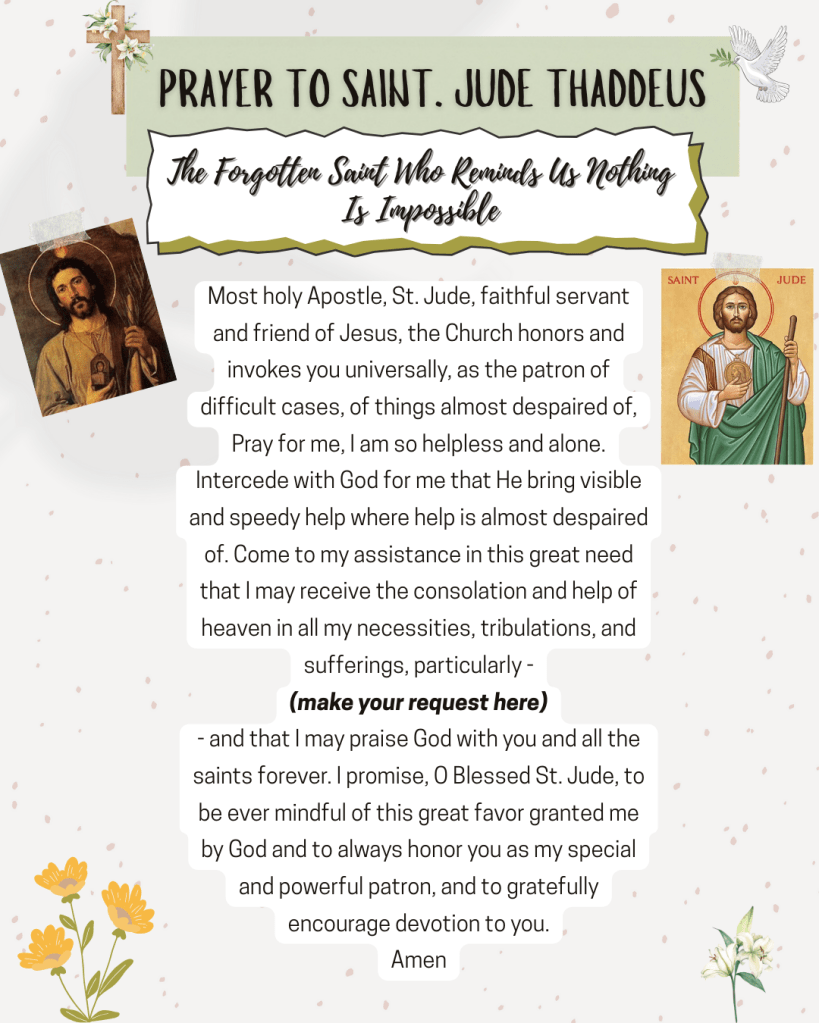
I’ve left his prayer down here, so if you would like, you can offer him your petition so he can take it up to God for you. Or if you just like learning to learn, I hope you enjoyed this piece.
xoxo – Blanca
Don’t forget to subscribe below to receive email notifications for my next blog post! Or, if you prefer, follow me on Instagram where I post updates for every new blog entry!
 A Little More Inspired
Leave a comment