
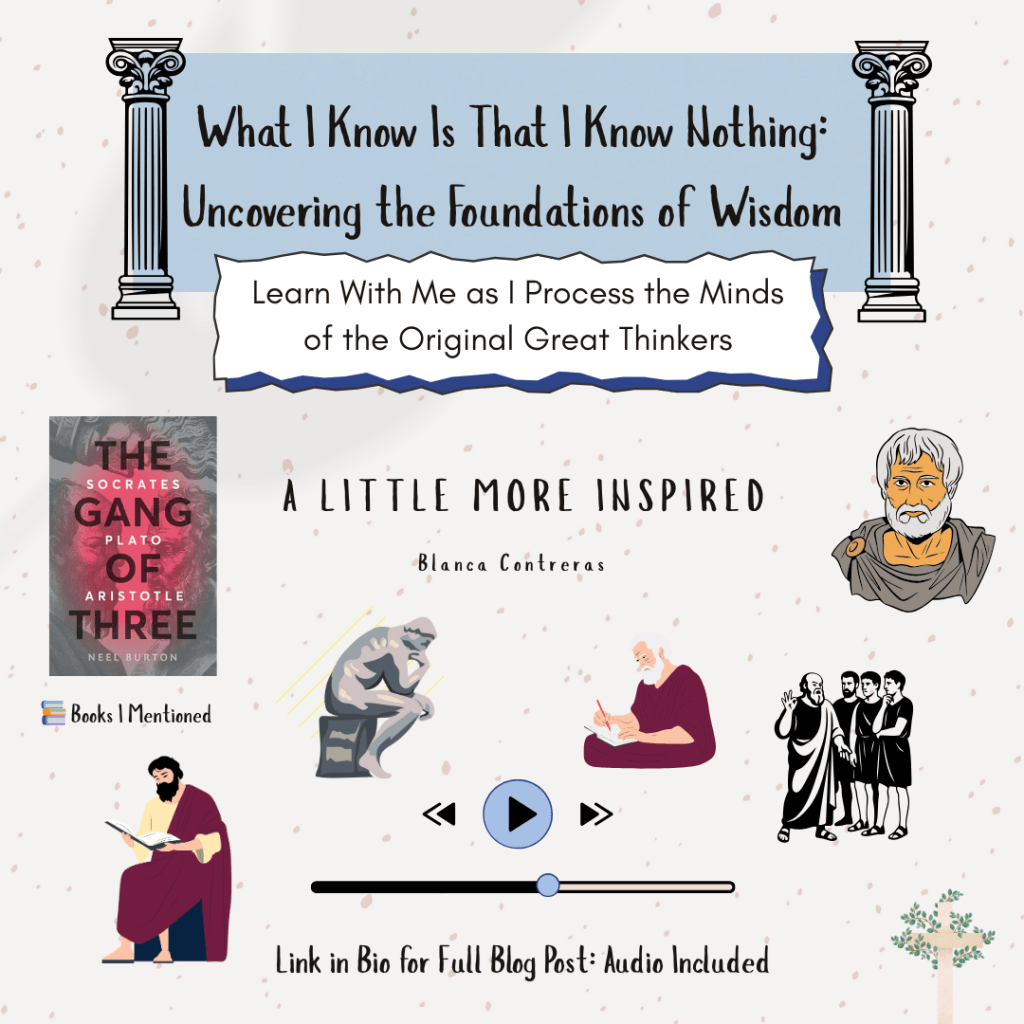
If you’d rather listen than read, I’ve added an audio version for your convenience!
I recently started a new job that’s been taking up a lot of my mental space. As I get more settled and balance full-time work with my everyday hobbies, I’ve found that the opportunity to sit down and get creative has become a little harder. So I’m excited to finally have a moment to jot down some of my thoughts on what I’ve been reading and learning lately.
If you follow my blog, you know I’m a deeply spiritual person and have been in a phase of being completely fascinated by the saints. I don’t go looking for them; it’s more like I follow those intuitive pings of curiosity, and I’m always pleasantly surprised by what I learn about these remarkable people. Somehow, their lives and teachings end up aligning perfectly with whatever lessons I happen to be learning in my own life. But I’m like that with everything. Please don’t watch a movie with me if I find out a character is based on a real story. I will need a solid 30 minutes to go down a rabbit hole on the internet to satisfy my need to know more about them.
Well, I’m on a new ping of interest, one I didn’t expect to fascinate me so much. I’ve been diving into the world of the great Greek philosophers, the very thinkers who laid the foundation for so much of how society operates today. But I feel like along the way, we’ve lost the plot about their insights and teachings.
This interest of mine really began after learning about St. Thomas Aquinas, the saint of higher learning and education. He came centuries after the Greeks but was deeply inspired by them, especially Aristotle and his views on God, the soul, virtue, and integrity. St. Thomas Aquinas was a medieval saint who dedicated much of his life to explaining and proving the existence of the Divine. He wrote remarkable works in an effort to make spiritual living more understandable to everyday people. He believed that reason and spirituality should go hand in hand and that missing one or the other could send us into extremes, that a balance was needed to fully live a virtuous life.
Anyway, I’ve been trying to get my non-intellectual brain to understand some of his writings, but I’ve found them quite difficult. So I decided to take a step back and start with the people who inspired him. My original goal was to learn about Aristotle, but one thing led to another, and I realized I needed to go even further back to the beginning. Because what better way to understand Aristotle than to learn where he got his ideas?
So here I am, reading a book called The Gang of Three by Neel Burton to begin my journey into the minds of the great thinkers. And let me tell you, I’m completely captivated by their intelligence. I know you’re probably thinking, “Well, duh, we learned about them in school.” Well, I didn’t, okay? I mean, maybe I did, but I definitely didn’t have the comprehension to fully appreciate the well of knowledge they had to offer. Why aren’t we learning more about them? Or maybe you’re thinking, Girl, you’re acting like you’re the first to know. Well, in my world, I am just really learning about them, so just let me enjoy my new hyperfixation and process it the way I need, please.
I’ve noticed that in bookstores, the philosophy section is usually tucked away in some tiny, dark corner with dust bunnies, while the rest of the shelves are filled with books on imagination and novelty. Don’t get me wrong, I think those books are wonderful. I’ve loved many of them myself. But I gotta be honest, those books one day just stopped being entertaining to me. I can barely sit through a fiction book anymore. If it’s not feeding me internally, I just can’t read it. I’m a self-help/spiritual junkie I fear. Anyway, I really believe we could learn so much about life and about mastering our minds, if we gave ourselves the chance to explore how these guys thought.
I haven’t even gotten to Aristotle yet, though I’m excited to. Right now, I’ve been learning about the very first great thinkers, the ones who actually sat down and asked, “What is the meaning of life, and how did we get here?” Socrates is who I’m focused on at the moment, and honestly, he was quite the guy for his time. But before him came Pythagoras, Xenophanes, Heraclitus, and Parmenides. The pre-Socratic thinking baddies who basically got society to pause and reevaluate everything they thought they knew about the gods, setting the foundation for how most of us see God now. They questioned, was God really just a bunch of dramatic, insecure characters who acted just like us?
My favorite so far? Heraclitus. He was known as the “Weeping Philosopher,” because apparently, his realizations about how asleep and shallow most people were made him genuinely sad. I really resonated with him, his view that most people don’t care about truth or justice, only money and popularity, feels very much like, damn, we really never change, huh? And that obsession with the superficial actually causes people a lot of internal suffering. All of these men helped move humanity away from the belief in many gods, critiquing the mythologies of Homer and Hesiod, which portrayed the gods as immoral, dramatic, and overly human. One of the boldest thinkers in this regard was Xenophanes.
He was the first to suggest the idea of one God, greater than all men, unlike them in form or thought. He basically asked, “Why would gods be like flawed humans? Why would they be selfish, emotional, or have the same petty dramas as we do?” He has this famous quote where he says that if horses could paint, they’d make gods look like horses. His point? We tend to project our own traits onto the divine instead of trying to understand what a divine being actually might be like. He was misunderstood by some as an atheist, but he wasn’t denying God. He was just challenging the idea of many flawed gods. He believed in one divine presence: singular, unchanging, and motionless. A being that just is –in everything. And honestly, that’s such a beautiful and profound conclusion to come to on your own.
When I think about them and the revolutionary conclusions they arrived at—truths that now feel so obvious to someone like me who was raised seeing God as the one ultimate being, I can only imagine how wild and disruptive their ideas must have felt like at the time. To contradict what the ancient Greeks had believed for centuries? That couldn’t have been easy. In many ways, each of these great thinkers was a social disrupter, and I deeply respect that. And of course, beyond their spiritual contributions, these men also helped lay the foundation for science, mathematics, and ethics.
What I love about these pre-Socratic thinkers, and what continues with Socrates, is their deep humility. It’s something I continue to see in all the great thinkers and saints I learn about: the golden virtue of humility.
Now, if you don’t know what true humility is, let me clarify. It’s not pretending to be dumb or constantly self-deprecating and denying yourself opportunity. It’s the awareness of our own human limits, especially the limits of human knowledge. These early philosophers believed there are boundaries to what we can fully grasp, particularly when it comes to truth, the Divine, and metaphysical realities. Even if we were to somehow stumble upon the truth, we might not even recognize that we have it. That’s how humble human reason must be.
In many ways, they believed that our purpose as human beings is to become wise, and that the soul can only grow in wisdom through inner clarity and discipline, not by being tossed around by emotions and cravings. These original men laid the foundation for so much of what would later appear in Stoic philosophy and even in the Bible. They believed in having a deep internal life, and that the internal life would lead you to truth aka our intuition.
Heraclitus, for example, inspired the Stoics, who believed that the universe is infused with Logos, also known as divine reason. They taught that living in alignment with Logos brings peace. And that very same word, Logos, would later appear in the Bible. But of course, over time we’ve butchered its meaning. In English, it’s often translated simply as “the Word,” but Logos means so much more than that. In the Stoic tradition, Logos means truth, order, divine mind, and meaning. Learning about this has made me feel like we need to revisit these teachings, not just to admire them, but to apply them. It’s also helped me realize that spirituality and life are really about learning. Truth and knowledge never end. We’re meant to stay in a constant pursuit of it, not clinging so tightly to our current beliefs that we become the very thing we fear: ignorant.
After learning about these foundational thinkers, the ones who laid the groundwork for everything that followed, comes Socrates. He’s considered the first truly famous philosopher, someone who would later inspire and shape Plato’s and Aristotle’s work. Plato often used Socrates’ voice to explore and express many of his own ideas, which I find so fascinating. Basically, at the beginning of his career, he didn’t have the confidence to say it with his whole chest what he believed. So he would create/write conversations with Socrates as the one he was discussing these ideas with, because of Socrates’ credibility. I guess now they don’t know if those were actually real recorded conversations or his own internal thoughts.
I actually want to dedicate a separate post just to Socrates and his teachings, because there’s so much wisdom there. His entire philosophy centers on the idea that humility and the pursuit of knowledge are the keys to freeing both the mind and the soul. But for now, I want to end this post with one main takeaway: Ignorance is born when we stand in pride, believing our beliefs are the only ones worth exploring. Which is sadly what I see so much of in today’s society. Everyone is trying to prove that they’re the ones who know the right way to live. That our beliefs are correct, and everyone else should suffer and not learn anything other than what we believe. I mean, they want us all to be stupid.
When we do that, we cut ourselves off from the fruit and nourishment that can only come through learning and expanding. True growth happens when we allow ourselves to be curious, purely curious. Not defensive, not bitter, not trying to prove anything—just open. I learn and share not because I want you to think I’m smart, because I’m not. It’s only in my healing years that I’ve fallen in love with learning. Only a few years ago, I was a deer in headlights. But I share because I find this fascinating, and I hope it can inspire curiosity in someone else.
You can learn something from everyone if your heart is in the right place.
Too often, we get upset when the world doesn’t reflect our beliefs, and instead of expanding, we become bitter, ugly Oompa Loompas like the people in charge of all of our human rights at the moment. We limit ourselves and others from the beauty of growth. Learning new things is not dangerous. Your beliefs being questioned does not put you in danger. If anything, I think questioning our own beliefs strengthens them and refines them, to see where the gaps in our thinking are. Why wouldn’t you want to refine your thinking? Wtf.
Learning about these early social disrupters has reminded me that I don’t know everything. And strangely, there’s such beauty in that knowing. I am so excited to learn from the never-ending journey of: truth.
I hope you leave feeling a little more inspired.
Y’all heres a classical bop for your brain to enjoy 🙂
Don’t forget to subscribe below to receive email notifications for my next blog post! Or, if you prefer, follow me on Instagram where I post updates for every new blog entry!
 A Little More Inspired
Leave a comment