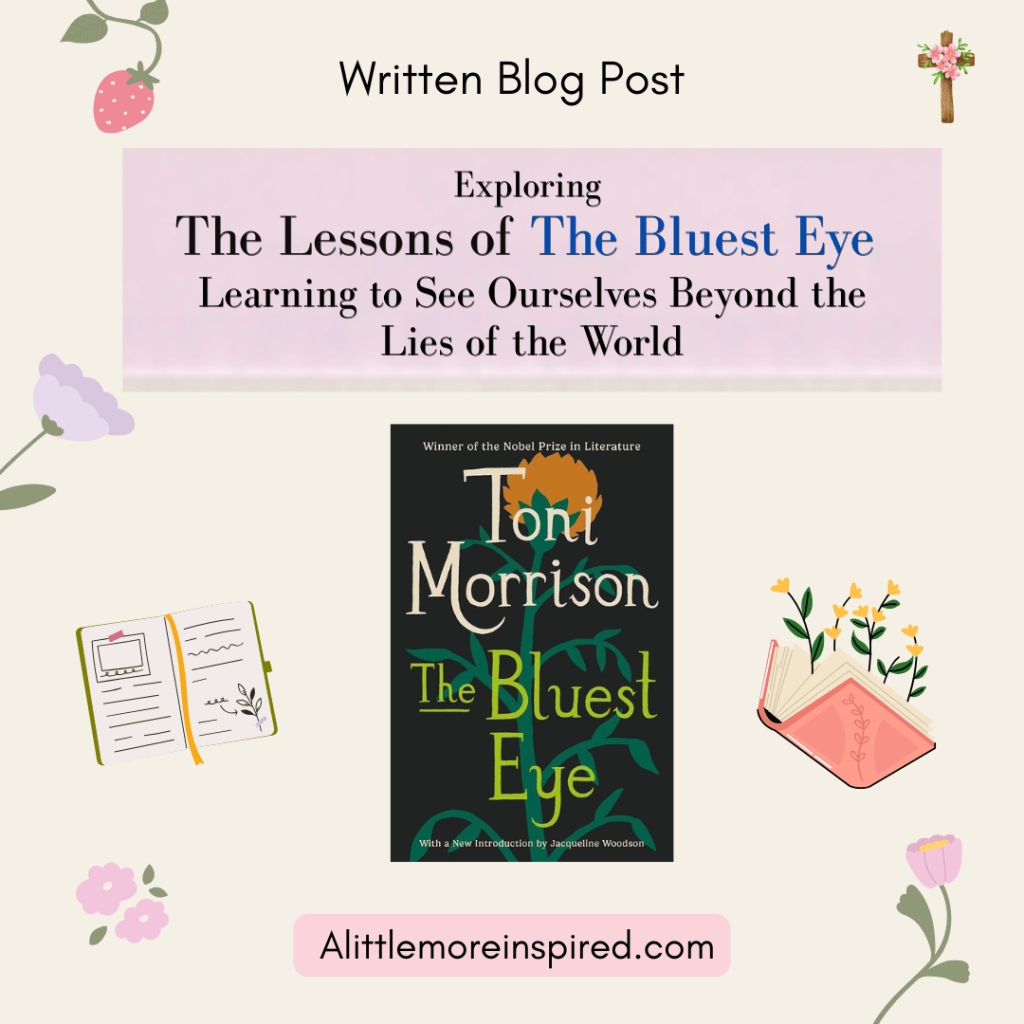
As always, I like my book reviews to lead me down rabbit holes into my own life. So this is part book review, part personal reflection.
I recently went on a long car ride with my sister after we spontaneously decided to take a trip to Myrtle Beach and get away from our everyday routine. My mom encouraged us to go, saying it would be fun for us, and she was right. Now, I don’t necessarily recommend Myrtle Beach at the end of September, it was a ghost town but my sister and I got to bond, spend some quality time together, and just enjoy being somewhere different for a day lol. On the way there, my sister was driving, so she was in charge of the radio. But on the seven-hour drive back to DC, I was in charge, and I asked her if she minded if I listened to an audiobook for a book I’d been craving to read but haven’t had any time for. She said to go ahead, and I began my journey through my first Toni Morrison book experience. I’d seen several book reviews, Reels, and people on the internet state this was one of their favorite books, so I’d kept it in mind for a while. I had already heard The Bluest Eye was a heavy read. I think I saw an Oprah interview where she told Keke Palmer she hadn’t made the book into a movie because it was too sad for her to be the one to create it. So, I understood I would be going on an emotional ride as I listened.
The Bluest Eye by Toni Morrison focuses on three main girls: Pecola Breedlove, who is the little girl you will grow to love and witness a life of a series of hardships and tragedies, and her two friends, Claudia, whose voice narrates the story, and her older sister Frieda. The book hits on many different themes, such as beauty standards and proximity to whiteness, internalized racism and colorism, childhood trauma, generational trauma, and family dysfunction. I was engaged in the story from the very beginning as the voice of Claudia vividly describes her surroundings and the adults around her. You get a clear picture of the types of adults that are influencing the girls and the kind of society they are living in. I liked that Toni starts off the book by explaining her inspiration behind this novel and the experience she had as a young Black child in the United States, recalling a time when she was 11 years old and her friend had told her she wanted blue eyes. She remembered being disturbed by the statement, because she thought her friend to be beautiful and could not understand why she would want to change her appearance. As I listened to the book, I couldn’t help but draw parallels to my own childhood experiences, and while Pecola’s is a much more tragic story, I realize the importance of good adults being sprinkled in the lives of young children, who can guide them or explain to them sometimes the heaviness of the ignorance that plagues our world.
While I probably cannot get to every single theme the story explores in this blog post, I highly recommend reading or listening to the book so you can reflect on yourself and the ways we unconsciously accept and perpetuate harmful ideologies within ourselves and onto others.
Sometimes, to me, it feels like something happened within each of our families, especially those that come from harsh conditions or generations of deep trauma, where no one really knows where it began. It feels like a poison that was planted long ago that we continually inherit and pass on to our descendants. Maybe it is self-hate that eventually translates into hatred of others who are different from us. Stories like these remind me how important it is to constantly seek clarity, truth, and mercy for ourselves so that we can see our realities clearly, rather than through tainted glasses that cloud our judgment and cause us to perpetuate the very thing we wish to avoid: suffering.
Toni Morrison wrote this story in the 1960s, setting it in the 1940s, but its lessons still ring true and remain relatable today. Even as we see greater representation of different cultures and people in the media, resistance to that representation remains shockingly present. And although Morrison explores deeply ingrained, internalized racism within the African American community, I recognize many of those same patterns within my own culture as a brown Salvadoran Latina.
Love is a reflection of the lover
Pecola is a vulnerable little girl, the most innocent of all the characters. To me, she is an angel in human form who is born into this sometimes harsh life and absorbs the trauma and hurt of the people around her. Pecola, out of all the people described in the story, is the most kindhearted, the only one who doesn’t judge anyone even though she is the victim of so much injustice and cruelty. She views the world through rose-colored glasses, unable to see the truth of those around her; her only desire in life is to be loved by somebody. Yet all the people around her who have been assigned to love her fail at protecting her or teaching her about her inherent value as a human being.
The story has a way of humanizing each character, even ones so grotesque you can’t quite believe there are really human beings exactly like this out there in the world. You realize that everyone, at some point in their life, was a child who started off at ground zero, followed by a series of events and people who came into their lives, influenced their character, and helped shape the kind of individual they would eventually become. It also taught me that there is no telling how each person in the world will ultimately internalize the events that occur in their life, especially when a community systematically strips away the things a child needs to develop a healthy sense of self-worth.
The book has a quote “Love is never any better than the lover,” which has stuck with me. Morrison says that love can only be as good as the person doing the loving. Cruel people express love cruelly, violent people through violence, weak people love weakly, and foolish people love foolishly. The mere existence of “love” doesn’t make a relationship good or safe; the lover’s own character shapes what that love becomes. This quote made me think about how I love people. What is the manifestation of my love for others, and what am I doing to make sure my love is one I’m proud of? Some people internalize the trauma in their lives and become violent, while others internalize those events and become weak. Others pretend to be someone they are not while their insides are barely holding on.
Pecola, as Toni describes at the end of the book, is the individual who, instead of projecting outwardly, internalizes everything. Every look, every word, every mistreatment—she turns it against herself rather than against those around her. She begins to believe that if only her appearance could change to resemble the baby dolls popularized in the media or the stars of the time, like Shirley Temple, maybe she would finally be loved. She even witnesses her own mother treating the little blonde, blue-eyed girl she works for more softly and tenderly than Pecola has ever experienced from her.
Slowly, Pecola comes to believe that maybe if she were a different person, with a completely different appearance than the one God gave her, she would finally receive the love she is so desperately longing for.
Does Your Spirituality Reflect the Quality of Your Heart?
Personally, I believe it is impossible to truly know how to love another person when we do not yet understand what true love is or have encountered its ultimate source. For me, that source is Jesus Christ. He is the perfect example of love. He was perfect, yet we failed to recognize Him and crucified Him. Still, He responded with the very thing we did not deserve, yet He gives unconditionally: mercy. Through His mercy, sacrifice, and resurrection, we are able to experience what true love looks like and, in turn, learn how to love others more like Christ. It is a deeply personal journey, though, to get to this place of true love. To accept it and embody it takes great self-reckoning and personal responsibility. We have to continually confront the parts of ourselves that prevent us from loving like Him.
I was struck by all the individuals in the story who use Christ or religion as a way to justify their actions. I’m also very aware of the false teachings and rationalizations of Christianity that have long caused more harm than good in the world. It makes me understand why the saints I read are so adamant that true spiritual growth cannot simply be measured by how religious someone appears to be. Humility, love for God, and genuine love for others are much truer indicators of whether we are actually becoming more like Christ.
It also reminds me that my spirituality has to first be practiced and worked through in how I treat myself and, especially, how I treat my family. One thing I have feared a lot throughout my journey with my Christian Catholic faith and spirituality is making sure that I never do any of it for show. I don’t want to become so focused on what other people think of me, how holy I appear, or how good other people believe I am. Ultimately, I want God to be the one who is proud of me.
Pauline, Pecola’s mother, made me think about this a lot. She uses religion as a way to feel righteous. In a strange way, she almost needs her piece-of-poop husband around because his failures give her something to measure her own goodness against. His shortcomings become proof of her righteousness, even while she is causing tremendous harm herself. She almost wants him to continue self-imploding because if he were to change, she would lose the person whose failures make her feel “good”.
To me, this is the opposite of what true love desires for another person. Loving someone does not mean we have the power to change them, we don’t. But we can still desire their healing. We can pray that they evolve out of their darkness, destructive habits, and sin, not because their transformation benefits our own image, but because we genuinely want what is good for them. It makes me think of St. Monica, who prayed for years for both her husband and her son as they struggled with their own destructive behaviors. She could not force either of them to change, but she could continue hoping and praying for their transformation.
Examples like this remind me why so many people have such a bad taste in their mouths when it comes to religion. We can become so focused on looking the part that we forget our hearts are supposed to become the part. We can focus so heavily on the Christ of Judgment Day that we lose sight of the merciful Christ—the Christ who asks us to love, forgive, serve, and examine ourselves before condemning everyone around us. For me, that is the real test of spirituality. It is not how religious I appear to other people, but whether my relationship with God is actually transforming the way I love the people closest to me.
Internalized Racism and Colorism
The colorism part of the story also really struck me, which is what the whole story is mainly about. The dangerous pedestalization of Eurocentric features and what this false messaging can do to those who are most vulnerable is something that really stayed with me. Pecola, after years of abuse and neglect, eventually experiences something so traumatic (I’ll let you read the book) that it leads her to lose all sense of reality. Her mind, protecting her from the harshness of the world, convinces itself that she finally received the blue eyes she longed for, keeping her in a state where she can no longer fully return to reality or to the young, innocent little girl you know, in your heart, deserved a different ending.
First of all, this messaging that white, blue-eyed beauty is the ultimate standard is so annoying and boring, and I am sick of it. It is like a nasty plague that needs to be scraped off the earth because I am sick of how much damage it has caused. Personally, I understood exactly how each of the girls processed these beauty standards because, at some point in my life, I too felt that way. I longed for a different face, different skin, and different features. Now that I have actively done my best to heal my own internalized colorism and self-hatred, it pisses me off because these are all lies that we ignorantly absorb, confidently believe, and then push onto every new child born.
I am Latina, and as a Salvadoran Latina, I have seen this firsthand. In the novelas we watched as a child, which are filled with white Mexican actors, you’ll never find a single brown Mexican person in sight. Even though theyre the majority. There is the idea of “bettering the race,” where you are encouraged to find a light-skinned partner so your children are not “plagued” with the features of their Indigenous ancestors. There is also the erasure of Afro-Latinos from our understanding of history, when so much of our culture is actually a beautiful blend of Indigenous, African, and forced European ancestry.
Personally, I relate to people making assumptions about you without even knowing you. Latinos are notorious for giving each other a hard time over who comes from the “best” nationality, comparing beauty, or making comments related to how white or non-white you are. I have had comments made to me about not staying in the sun too long so I wouldn’t get any more “negra.” I internalized that self-hatred, and at one point in my life, I thought I was the ugliest thing on the face of the planet. I’ve had annoying, self-hating aunts compare me to the oh-so-pretty white cousin, asking, “Why couldn’t you be as pretty as her?” Like, girl, be so for real. EYES ROLLED.
It has taken deep internal work to learn to love this body God gave me, to stop internalizing that self-hatred, and to make sure I don’t project that hatred onto others. I am grateful that, even with all the harmful comments I experienced, I still had a sliver of self-esteem. That small piece of me survived, and I am grateful for it because it gave me something to work with when I eventually began the process of learning to love myself. To love my Indigenous roots, my Indigenous nose, and my brown skin.
Shoot, other Latinos will look down on you for being Central American, like that is somehow something I can control. MAKE IT MAKE SENSE. Sometimes the hate you receive from others is crazy and unjustified, and finding your way through it without allowing yourself to be pulled down into it can feel impossible. I think about all the Pecolas of the world. The little ones who don’t even have that little tiny piece of self-worth. The ones who didn’t have a grandma on the side to give them some sense of self. I pray that they may find someone who teaches them to see themselves as worthy of existing, worthy of being loved, and worthy of being them, exactly as they are.
While ideally I wish I could shake the ignorance out of the oppressors and slap them into a reality check, I realize that my revolution is one I have to do internally. I might never convince the world that white beauty is not the standard, but I can change myself. I can learn to love me the way Christ loves me. Because one day, we will meet our Creator, and He will have no favoritism when it comes to skin tones. We all bleed the same color, and I have to become the person I want the my world to be. Hopefully, one day, if I have little ones, or if I have the opportunity to shape a little one who is brought into my world, I can teach them to love their brown skin the way I wish I would have always loved mine.
As adults, we need to grow up and stop taking our internal wars out on children. Stop beefing with little kids like you’re beefing with your friend, you weirdo. We all had that weird family member who was beefing with 7 year old us, for noo reason lol. We say the most outlandish things to them and then expect them not to catch it. That’s another thing this book reminds me of: you have to explain things to children because they understand everything. They’re not just little blobs who don’t know anything. Sometimes what traumatizes a child isn’t even necessarily the experience itself, but the fact that no one explained to them that it wasn’t about them. They were left to their own imaginations and came up with their own conclusions, creating a deeper mark than there ever needed to be.
I think there is so much more I wish I could have shared about this story, but this post would be never-ending. I’ve already started my next Toni Morrison book, Sula, so I’ll be back for that.
As always, I hope you leave feeling a little more inspired.
Don’t forget to subscribe below to receive email notifications for my next blog post! Or, if you prefer, follow me on Instagram where I post updates for every new blog entry!


Leave a Reply